
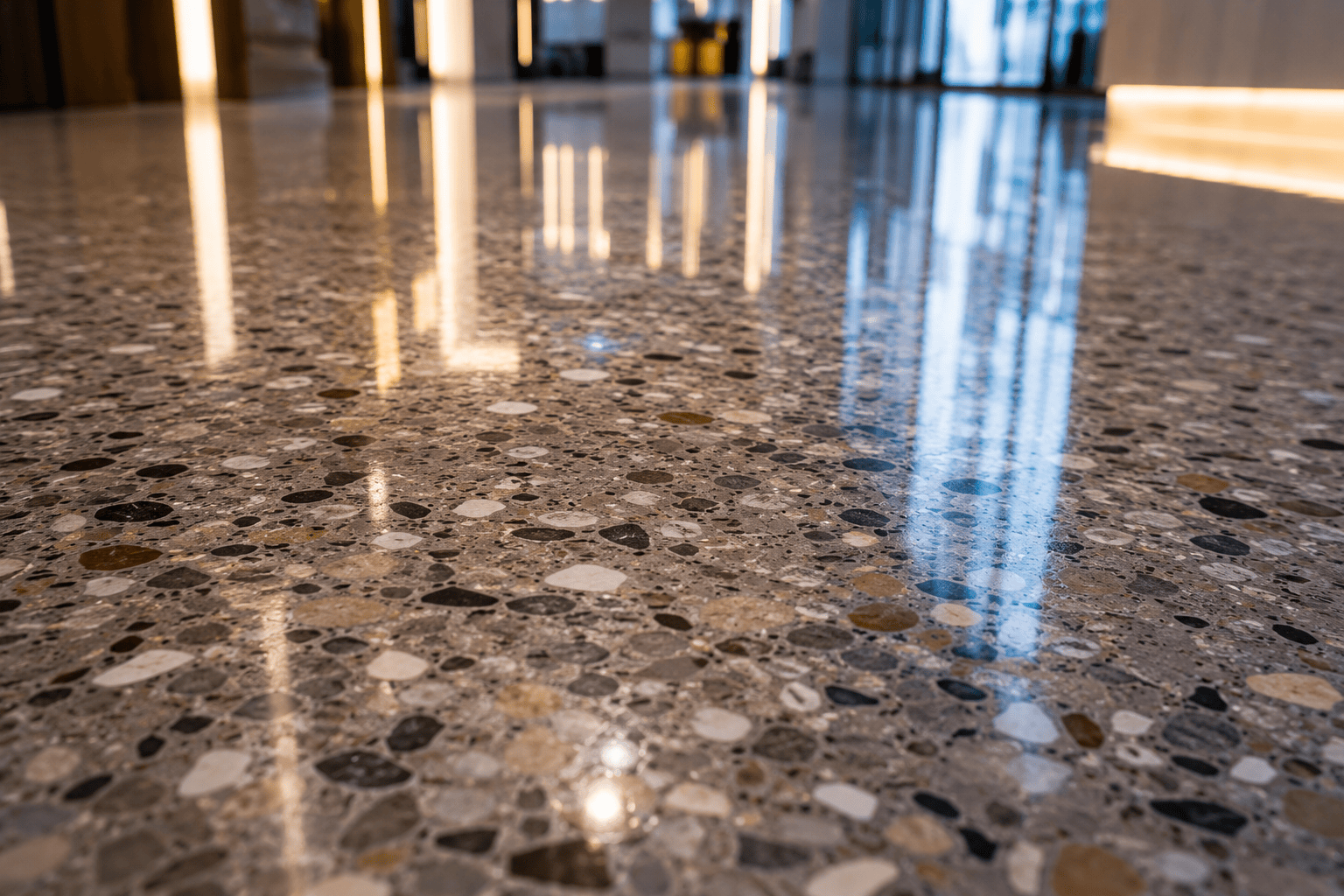
Terrazzo floors have a particular way of disappointing their owners over time — not through any sudden damage, but through a slow, almost unnoticeable dulling that eventually becomes impossible to ignore. One day you look down and realize the floor that used to catch the light now just looks flat and tired. The good news is that this is rarely a sign the floor needs replacing. It's a sign it needs proper restoration, which is a specific, well-understood process most people have simply never seen explained.
Why terrazzo dulls in the first place
Terrazzo is a composite surface — marble, granite, or glass chips set into cement or resin — and its glossy finish comes from the original installation polish and any sealant applied at the time. Over months and years, foot traffic gradually wears down that finish, fine scratches accumulate from grit and debris tracked across the surface, and the original sealant breaks down, leaving the porous terrazzo more vulnerable to staining. None of this happens overnight, which is exactly why it's easy to miss until the floor looks noticeably different from how it started.
What regular cleaning can and can't fix
Regular mopping and cleaning keeps a terrazzo floor free of surface dirt, but it does nothing for the deeper issues — it can't restore a worn finish, fill in fine scratches, or replace a degraded seal. This is an important distinction, because some people increase their regular cleaning frequency in response to a dull floor, when the actual problem requires a completely different process entirely.
Step one: a real deep clean, not just a mop
Before any restoration work begins, the floor needs a deep clean that removes built-up grime and old sealant residue — the kind of buildup that standard mopping has been working around, not actually removing, for a long time. This step alone often reveals how much of the dullness was surface buildup versus actual wear in the terrazzo itself.
Step two: diamond grinding
This is the step that actually addresses physical wear. Diamond grinding pads level the surface and remove scratches and imperfections, using the same method employed during original installation finishing. This isn't an aggressive process meant to remove material recklessly — it's a controlled, gradual process that reveals the fresh terrazzo surface beneath years of wear.
Step three: multi-stage polishing
Once the surface is ground level and smooth, polishing happens in progressively finer stages, each pass bringing back more of the glossy finish than the last. This is why terrazzo restoration can't be rushed into a single quick pass — the shine builds gradually through multiple stages, not one aggressive buff.
Step four: sealing
The final step applies a protective sealant that guards against future staining and moisture damage. This is what extends the time before the next full restoration is needed, and skipping it — or using a low-quality sealant — is part of why some 'restored' floors lose their shine again within months.
How often this actually needs repeating
This depends entirely on foot traffic, not a fixed calendar interval. A terrazzo floor in a quiet residential home might go several years between full restorations. The lobby of a commercial building with constant foot traffic will need attention far more frequently. An honest assessment of your specific floor and how it's used should determine the schedule, not a generic recommendation.
What to expect if your floor is severely worn
Even significantly dulled or scratched terrazzo is usually restorable through this process — diamond grinding can remove a surprising amount of surface wear. The honest exception is structural damage like cracking, which restoration doesn't address. A proper assessment will tell you clearly what's realistically achievable for your specific floor before any work begins. This is the approach behind our terrazzo and cabro maintenance service.
If your terrazzo floor has lost its shine, book a site visit and we'll give you an honest assessment of what restoration can realistically achieve.
Book a Site Visit